
Flat roofs fail differently than pitched roofs. Water does not run off a flat roof — it sits, finds the lowest point, and works through whatever seam, flashing, or blister it finds first. That is why a flat roof leak almost never appears directly above the damage inside.
California Building Professionals repairs and installs flat and low-slope roofs across Los Angeles, from mid-century homes in Studio City and Sherman Oaks to ADUs, duplexes, and small commercial buildings throughout the San Fernando and San Gabriel Valleys. We diagnose before we quote, and we tell you when a repair will hold and when it will not.
How do you repair a leaking flat roof?
Repairing a leaking flat roof requires finding the actual entry point first, which is rarely above the interior stain. A proper repair involves locating the failed seam, flashing, penetration, or blister; drying and cutting back the wet substrate; and patching with a material compatible with the existing membrane. Patching a TPO roof with asphalt products, or torch-down with the wrong mastic, causes the repair to fail within a season.
Water entering a flat roof travels. It runs between the membrane and the substrate, moves along a joist, and drops through the ceiling at the first available gap. We have opened ceilings where the interior damage sat more than fifteen feet from the actual breach.
Because of that, we do not patch where the stain is. We inspect the roof surface systematically and look for the failure modes that actually cause flat roof leaks:
If the substrate underneath has stayed wet, a surface patch will not hold. In that case we cut out the saturated section, replace the decking or insulation, and rebuild the assembly. We will tell you that before we start, not after.
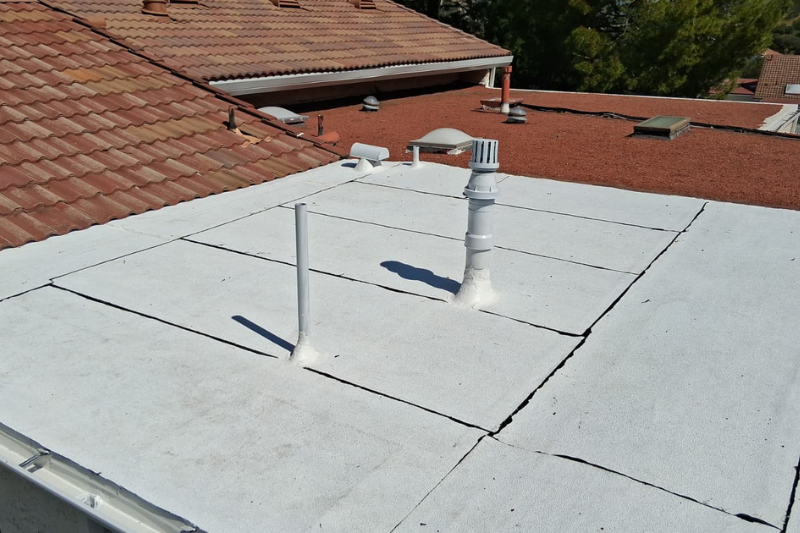
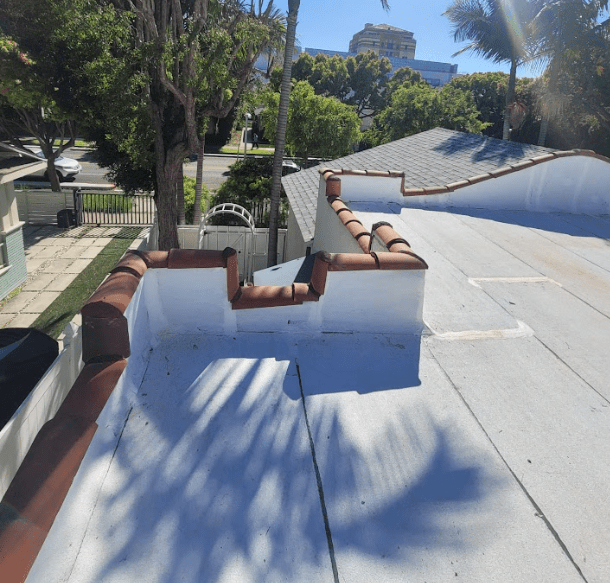
A flat roof is not truly flat. It is built with a slight slope, usually a quarter-inch of fall per foot, so water moves toward drains. When water still sits on the roof more than 48 hours after rain, something in that system has failed.
This distinction matters because the fixes are completely different. Recoating over a ponding area does nothing about deflection — the water comes back and sits on a new surface. A drain that is set an inch above the low point will never clear that low point no matter what you coat it with.
Depending on the cause, the correct fix is tapered insulation crickets to redirect water, adding or relocating drains, sistering or replacing deflected framing, or rebuilding the slope during a full replacement. Standing water is not cosmetic. It adds weight, accelerates membrane breakdown under UV, and finds every weakness in a seam.
There is no single best flat roofing material. The right system depends on the roof size, what is already there, foot traffic, rooftop equipment, and how long you plan to hold the building.
| System | Best suited to | Typical service life | Notes for Los Angeles |
|---|---|---|---|
| TPO (thermoplastic polyolefin) | Larger residential and commercial flat roofs, ADUs, new construction | Commonly 20–30 years when properly installed | White reflective surface helps with heat and can support Title 24 cool roof compliance |
| Torch-down modified bitumen | Smaller residential flat roofs, decks, roofs with many penetrations | Commonly 15–25 years | Very durable underfoot; well suited to complex detailing. See our torch down roofing page |
| Silicone roof coating | Sound existing roofs needing waterproofing and UV protection, not roofs with wet insulation | Commonly 10–20 years, renewable | Excellent ponding-water tolerance; seamless; can be recoated rather than torn off |
| Acrylic coating | Sound roofs in areas with good drainage | Commonly 10–15 years | Lower cost than silicone but does not tolerate standing water as well |
| EPDM (rubber membrane) | Commercial roofs, simple layouts with few penetrations | Commonly 20–30 years | Black surface absorbs heat unless a reflective coating is added |
The practical difference is water. Silicone holds up under ponding and stays intact when water sits on it; acrylic softens and can re-emulsify with prolonged standing water. If your roof has any low spots — and most Los Angeles flat roofs over ten years old do — silicone is usually the correct choice. Acrylic is a reasonable option on a roof with genuinely good drainage where budget is the deciding factor.
A coating is not a repair. Coatings work on a sound roof. Applied over wet insulation or an active leak, they trap moisture and hide the problem while it gets worse. We inspect and take moisture readings before recommending one.
A properly installed TPO roof commonly lasts 20 to 30 years. Torch-down modified bitumen commonly runs 15 to 25. Coatings typically give 10 to 20 years and can be renewed rather than replaced.
Los Angeles conditions push these in both directions. Our long dry season means far less freeze-thaw damage than most of the country, which helps. But sustained UV exposure and roof-surface temperatures well above ambient are hard on membranes, seams, and any exposed mastic. Reflective white surfaces and coatings measurably reduce that thermal load.
The other local factor is timing. Most of our rain arrives in a concentrated winter window, which means a flat roof that has been quietly failing all summer announces itself during the first real storm — usually at the worst possible moment. This is why we recommend inspecting flat roofs in early fall rather than waiting for a leak.
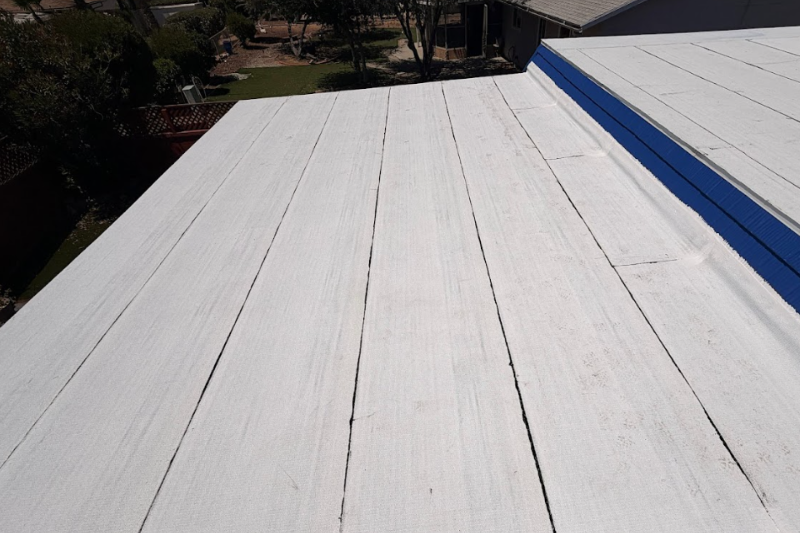
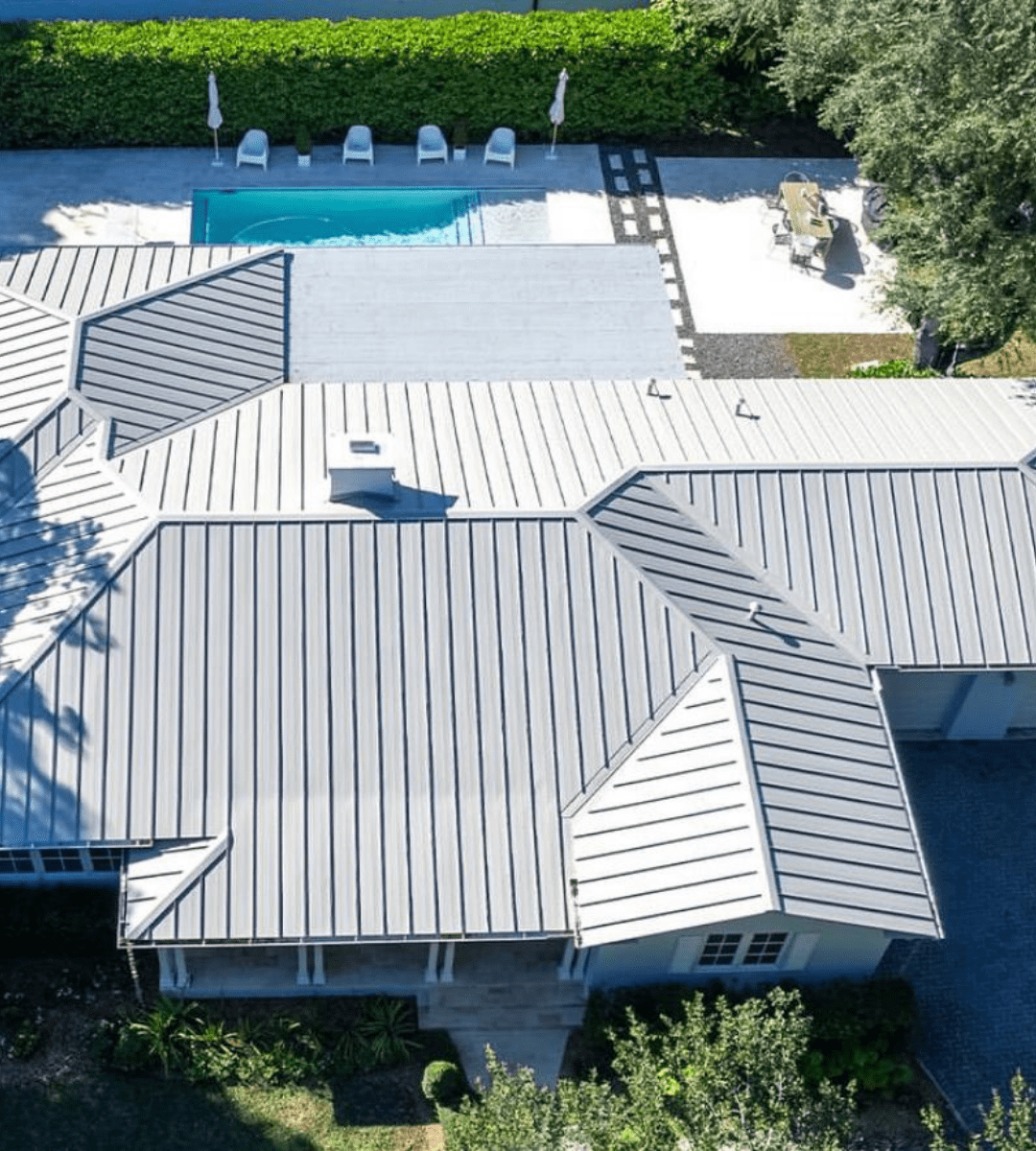
Flat roofing is a detail trade. The membrane field almost never fails on its own — the failures are at transitions, penetrations, and terminations, which is exactly where inexperienced crews cut corners. A torch-down job with a poorly executed parapet flashing will leak no matter how good the field looks.
Every flat roof repair is priced after inspection, because the cost is driven almost entirely by what is underneath. Two roofs with identical square footage can differ substantially. The factors that move the number:
We give you a written estimate after inspecting, and we will tell you plainly when a repair is not worth doing. If your roof needs full replacement rather than repair, see roof replacement.
Start at the roof, not the ceiling. Water travels between the membrane and the deck before it drops inside, so the interior stain is often well away from the entry point. Check seams, flashing at walls and curbs, penetrations around vents and drains, and any blisters or splits. If the roof has standing water, inspect that area closely — ponding degrades membranes and opens seams. A moisture scan identifies wet insulation that is not visible from the surface.
It depends on whether the substrate underneath is dry. If the deck and insulation are sound and the failure is localized to a seam, flashing, or penetration, a repair will hold. If moisture has spread through the insulation, patching the surface traps that water and the roof will fail again. As a general rule, if more than roughly a quarter of the roof has wet substrate, replacement is usually the better value.
Water remaining more than 48 hours after rain means the roof has lost its designed slope, the deck has deflected between joists, or the drains are blocked or set too high. Coating over a ponding area does not fix any of those causes. The correct repair is tapered insulation, added or relocated drains, or framing correction depending on which is responsible.
For most Los Angeles flat roofs, yes. Silicone tolerates standing water and stays intact where water ponds, while acrylic can soften and break down under prolonged moisture. Acrylic is a reasonable lower-cost option on a roof with genuinely good drainage. Neither should be applied over wet insulation or an active leak — a coating on a compromised roof traps moisture and conceals the problem.
A properly installed TPO roof commonly lasts 20 to 30 years. Installation quality at seams and flashings matters more than the membrane itself, since that is where nearly all failures begin. In Los Angeles, sustained UV exposure is the main aging factor, and TPO’s reflective white surface helps by keeping roof-surface temperatures down.
A localized repair generally does not require a permit. A re-roof or full replacement does, and California limits the number of roofing layers that may remain in place, which often forces a tear-off. Title 24 cool roof requirements may also apply to the replacement assembly. We handle permitting on replacement projects.
TPO and torch-down modified bitumen are both common on ADUs. TPO’s reflective surface helps with heat gain in a small structure and supports cool roof compliance. Torch-down handles complex detailing well and stands up to foot traffic. The right choice usually comes down to roof size, the number of penetrations, and whether the surface will be walked on.
Flat and low-slope roofs are concentrated in specific pockets of our service area rather than spread evenly across it. The mid-century and post-and-beam housing stock through Studio City, Sherman Oaks and the Valley floor accounts for much of our residential flat work, along with the ADUs and garage conversions that have gone up across the region in recent years.
We work throughout the San Fernando Valley, San Gabriel Valley and Central Los Angeles from our base in Tujunga — including Burbank, Glendale and Pasadena, along with La Crescenta, La Cañada Flintridge, Montrose, Altadena, Sunland, Encino, San Marino and Sierra Madre. See the full service area.
We inspect flat roofs at no charge and tell you honestly whether you are looking at a repair or a replacement. If your roof is holding water or you have seen a stain appear, get it looked at before the rain arrives.
California Building Professionals is a family-run, licensed and insured roofing contractor based in Tujunga, serving the San Fernando Valley, San Gabriel Valley and Central Los Angeles. CSLB License #1150891. Roofing since 2014.