
Torch down roofing — properly called torch-applied modified bitumen — is one of the most durable options available for flat and low-slope roofs, and it is particularly well suited to the kind of complex, penetration-heavy roofs common on Los Angeles homes, ADUs, and small commercial buildings.
California Building Professionals installs and repairs torch down roofing across Los Angeles. It is a system that rewards experienced installation and punishes inexperience quite quickly, because the seams are made with an open flame and either fully bond or they do not.
What is torch down roofing?
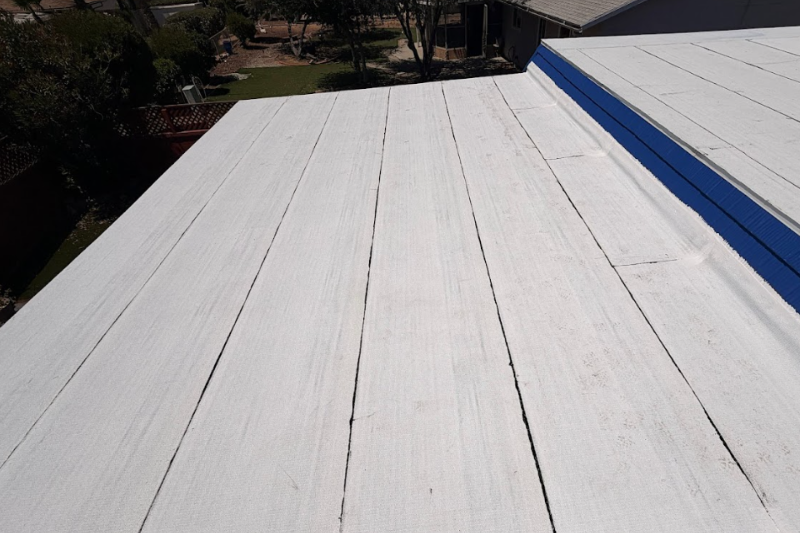
Torch down roofing is a flat and low-slope roofing system made from modified bitumen sheets that are melted onto the roof deck with an open-flame torch, bonding each sheet to the layer beneath and to adjacent sheets. It is typically installed in two or three layers — a base sheet and a granulated cap sheet — producing a thick, fully-adhered, seamless waterproof membrane. Torch down commonly lasts 15 to 25 years and stands up well to foot traffic.
Modified bitumen is asphalt reinforced with polymer modifiers — typically APP or SBS — and a fibreglass or polyester mat. It arrives in rolls. The installer uses a propane torch to melt the underside of the roll as it is unrolled, so the bitumen liquefies and fuses to the surface beneath.
A typical residential assembly runs:
Because each layer is heat-fused rather than mechanically joined or glued, a correctly executed torch down roof is effectively a single continuous membrane. That is its strength and its weakness. Where the bond is complete, it is extremely reliable. Where an installer moved too fast and the bitumen did not fully liquefy, you get a cold seam — a joint that looks bonded and is not, and which opens up a season or two later.
| Torch down (modified bitumen) | TPO | Silicone coating | |
|---|---|---|---|
| Service life | 15–25 years | 20–30 years | 10–20 years, renewable |
| Foot traffic | Excellent — granulated surface is tough underfoot | Moderate — can be punctured | Poor — not intended for traffic |
| Complex detailing | Excellent — conforms around penetrations and curbs | Good, but requires welded detailing | Excellent — seamless application |
| Heat reflectivity | Lower unless a reflective cap or coating is used | High — white reflective surface | High |
| Best for | Small to mid-size roofs, decks, penetration-heavy layouts | Larger open roofs, ADUs, commercial | Restoring a sound existing roof |
| Ponding tolerance | Good | Good | Excellent |
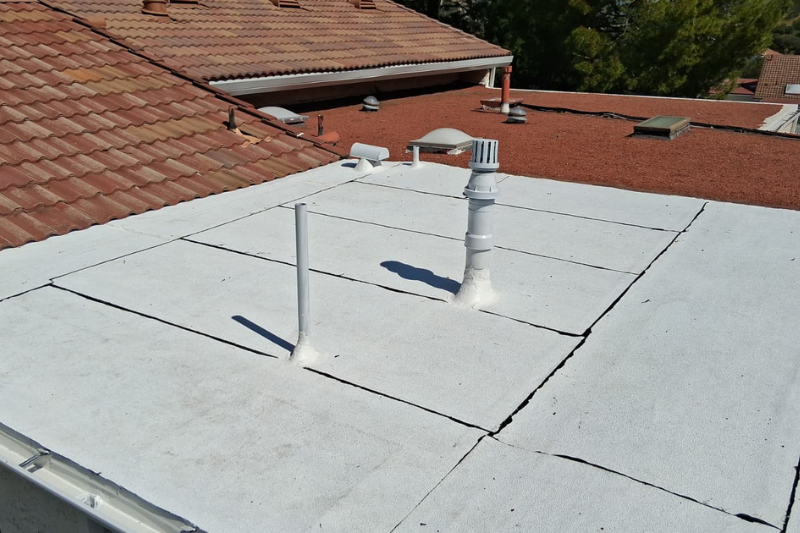
The practical rule: torch down excels where a roof has a lot going on. Multiple vents, curbs, skylights, parapets, changes in plane — modified bitumen conforms and details well around all of it. On a large, open, simple roof, TPO's reflectivity and sheet size usually make it the better choice. See flat roofing for the full comparison.
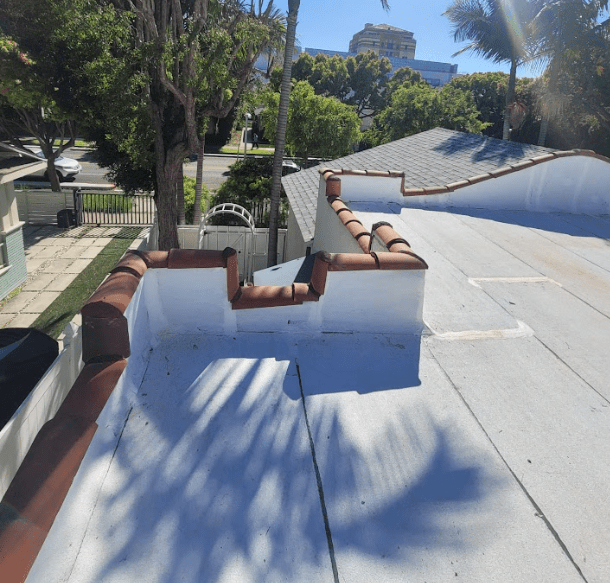
Worth being direct about: torch down installation uses an open flame on a building. Done by a careless crew, it is a genuine fire risk — torch-applied roofing has caused structure fires, and the risk is highest at parapets, walls, and any location where the flame is near combustible framing or concealed cavities.
Proper practice includes keeping the torch away from vertical combustible surfaces and using alternative methods at those details, maintaining a fire watch on the roof after the torches are shut down, and having extinguishers on site throughout. In the foothill fire zones around Tujunga, La Cañada Flintridge and La Crescenta, this is not a formality.
If a contractor is casual about this, that tells you what you need to know. We are licensed and insured, CSLB #1150891, and we carry out torch work to the practices the system requires.
Torch down is repairable, which is one of its advantages — a compatible patch heat-welded into the existing membrane becomes part of it rather than sitting on top of it. Common repairs:
Do not let anyone patch a torch down roof with the wrong material. Incompatible mastics and generic sealants do not bond to modified bitumen properly and fail within a season, and they can make the eventual proper repair harder. See flat roof repair.
Torch down is quoted after inspection. The main variables:
We will tell you whether torch down, TPO, or a coating is the right answer for your specific roof before quoting — they are not interchangeable, and the cheapest of the three is not always the least expensive over ten years.
Torch down roofing is a flat and low-slope system built from modified bitumen sheets that are melted onto the roof with an open-flame torch, fusing each layer to the one beneath. It is typically installed in two or three plies — a base sheet and a granulated cap sheet, sometimes with an interply — producing a thick, fully-bonded, seamless membrane. It commonly lasts 15 to 25 years.
A properly installed torch down roof commonly lasts 15 to 25 years. Three-ply systems generally outlast two-ply. The most significant factor is installation quality at the seams: where the bitumen was not fully liquefied during application, a cold seam forms that looks bonded but is not, and it typically opens within a season or two.
Neither is universally better. Torch down excels on roofs with heavy detailing — multiple penetrations, curbs, parapets, changes in plane — and stands up better to foot traffic. TPO offers a longer typical service life and a reflective white surface that reduces heat gain and supports Title 24 cool roof compliance, and it is usually the better choice on large, open, simple roofs. Roof size and penetration density are the deciding factors.
The installation uses an open flame on a building, so it carries real risk if handled carelessly — particularly near parapets, walls, and concealed cavities. Proper practice means keeping the torch away from vertical combustible surfaces and using alternative methods at those details, maintaining a fire watch after torches are shut down, and keeping extinguishers on site. Once installed and cured, a torch down roof presents no unusual fire risk.
Yes, and it repairs well. A compatible modified bitumen patch is heat-welded into the existing membrane and becomes continuous with it rather than sitting on top. The critical point is compatibility — generic sealants and incompatible mastics do not bond properly to modified bitumen, fail within a season, and can make the eventual proper repair more difficult.
Sometimes, but it is usually inadvisable. Torching over an existing roof conceals the condition of the deck beneath, adds weight, and can trap moisture in the old assembly. California also limits the number of roofing layers permitted to remain. Tear-off allows the deck to be inspected and any damaged sheathing replaced before the new system goes down.
Blisters form when moisture or air is trapped between layers and expands under heat. The usual causes are application over a damp substrate, incomplete bonding during installation, or moisture that has since entered through a failed detail. Small stable blisters can sometimes be monitored; growing blisters should be cut, dried, and patched before they split open.
It is a common and sensible choice. ADUs are small structures that often have tight, complex roof details relative to their size, and torch down conforms and details well in that situation. It also stands up to foot traffic if the roof will be accessed. Where heat gain is a priority on a small structure, a reflective cap sheet or TPO may be worth comparing.
Torch down turns up wherever there are low-slope roofs to cover: the mid-century homes of Studio City and Sherman Oaks, roof decks across the Valley, ADUs and garage conversions throughout the region, and small commercial buildings along the Foothill and Glendale corridors.
We install and repair throughout the San Fernando Valley, San Gabriel Valley and Central Los Angeles, including Burbank and Pasadena. One note specific to where we work: torch-applied roofing uses an open flame, and in the foothill fire zones around our Tujunga base we treat the fire-watch protocol as non-negotiable rather than as paperwork. Request an estimate.
We will inspect the roof, tell you whether torch down is genuinely the right system for it, and give you a written estimate with the assembly specified.
California Building Professionals is a family-run, licensed and insured roofing contractor based in Tujunga, serving the San Fernando Valley, San Gabriel Valley and Central Los Angeles. CSLB License #1150891. Roofing since 2014.