
If water is coming into your building right now, call (818) 688-4943. The rest of this page can wait.
California Building Professionals responds to active roof leaks and storm damage across Los Angeles, including nights and weekends. Emergency work is about stabilization — stopping water entry and limiting damage — so that the permanent repair can be done properly rather than in the dark and the rain.
What should I do if my roof is leaking right now?
Move valuables and electronics out of the affected area and place containers under active drips. If the ceiling is bulging with trapped water, puncture it at the lowest point with a screwdriver to release the water in a controlled way — a bulging ceiling can collapse. Shut off electricity to the affected area if water is near fixtures or outlets. Photograph everything for insurance. Do not go on the roof during rain or wind. Then call a licensed roofer for emergency tarping.
Being straight with you here saves you money. Not everything needs an after-hours call.
| Call immediately | Can wait for a scheduled appointment |
|---|---|
| Active water entering the building | A stain that is dry and has not grown |
| Sagging or bulging ceiling | A few missing shingles with no leak, in dry weather |
| Storm or wind damage exposing the deck | Minor granule loss in gutters |
| A tree limb or debris through the roof | Moss or debris accumulation |
| Tile or sections blown off with rain forecast | A drip that only appears in heavy, sustained rain |
| Commercial roof leak over inventory or equipment | Cosmetic damage with no water entry |
If you are not sure, call and describe it. We would rather tell you it can wait until Tuesday than have you pay emergency rates for something that is not urgent — and we would much rather hear about a small problem now than a large one in January.
Emergency roofing is triage, not treatment. The distinction matters because some contractors will present stabilization work as though it were a repair.
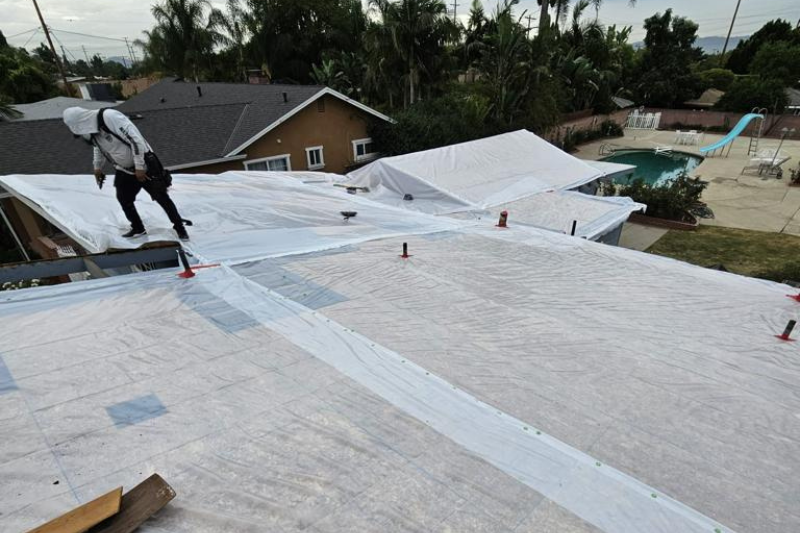
A properly installed roof tarp is not a sheet thrown over the damage and weighted with bricks. It is secured, run up-slope past the damaged area so water sheds over it rather than under it, and fastened so wind cannot lift it. A correctly installed tarp buys weeks of protection. A poorly installed one lasts until the next gust and can add damage where it was fastened.
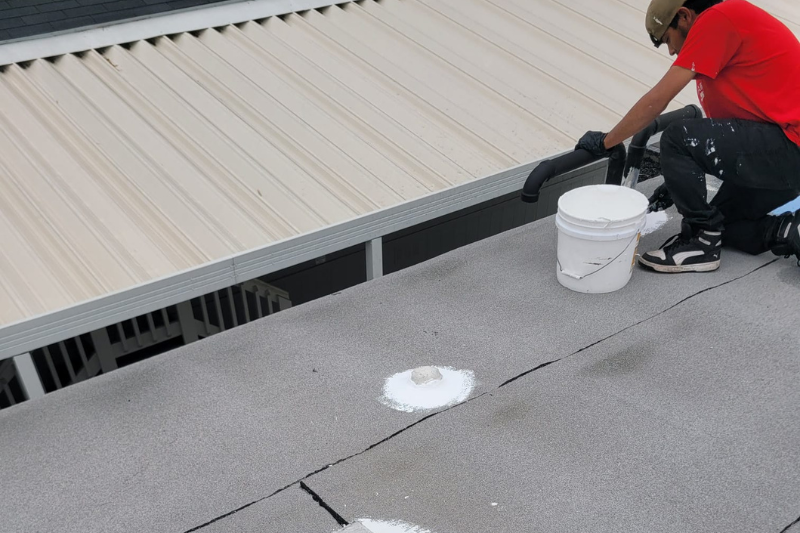
For localized breaches — a failed flashing, an open seam, a penetration — roofing mastic applied to a stabilized surface stops active entry immediately. On a wet roof in active rain, this is often the fastest route to a dry interior.
Neither of these is a permanent repair, and we will not tell you otherwise. Once the weather clears and the roof dries, we return to inspect properly, find every entry point rather than just the obvious one, and quote the permanent fix. Sometimes that is a roof repair; sometimes the emergency revealed a roof that is at the end of its life and needs replacement.
Los Angeles does not get many storms, and that is precisely the problem. Roofs here sit through a long dry season, then meet concentrated winter rain all at once. Damage that developed invisibly over months shows up in a single night.
The two events that generate most of our emergency calls:
After a wind event, it is worth having the roof looked at even if nothing is obviously wrong — particularly on tile, where a displaced piece exposes underlayment that will fail quietly until the rain finds it.
We are roofers, not insurance adjusters, and we will not tell you what your policy covers. What we can do is make sure you have what a claim requires.
Sudden, accidental damage — wind, a fallen limb, storm impact — is generally treated differently by insurers than gradual wear or deferred maintenance. Photograph early and call your carrier promptly either way.
Emergency work is priced on what it takes to stabilize the situation. The variables:
Emergency stabilization and the permanent repair are quoted separately, because they are separate work. We tell you what the stabilization costs before we start it.
Move valuables clear of the water and place containers under active drips. If the ceiling is bulging, puncture the lowest point with a screwdriver to release trapped water in a controlled way — a water-loaded ceiling can collapse. Cut power to the area if water is near fixtures or outlets. Photograph everything for insurance before you clean up. Do not climb onto the roof in rain or wind.
We respond to genuine emergencies outside normal business hours, including nights and weekends. Emergency response is stabilization work — tarping and sealing to stop water entry and limit damage. The permanent repair is scheduled once conditions allow the roof to be inspected and worked on properly.
A correctly installed tarp — secured, run up-slope past the damage so water sheds over rather than under it, and fastened against wind — provides reliable protection for several weeks. A poorly installed tarp may not survive the next wind event and can create new damage at its fastening points. Tarping is temporary protection, not a repair, and the permanent fix should follow as soon as conditions permit.
Active water entering the building is an emergency, particularly if it is near electrical fixtures or if a ceiling is sagging. A dry, stable stain that has not grown is not — that can wait for a scheduled inspection. If you are unsure, call and describe what you are seeing; we will tell you honestly whether it needs immediate attention.
That depends on your policy and the cause. Insurers generally treat sudden accidental damage — wind, a fallen limb, storm impact — differently from gradual wear or deferred maintenance. We are not adjusters and cannot tell you what is covered, but we document the damage as found, describe the likely cause in writing, and provide an itemized estimate, which is what most claims require. Photograph everything before cleanup and contact your carrier promptly.
Los Angeles roofs go through a long dry season during which UV degrades membranes and mastic, debris accumulates in valleys and drains, and wind displaces tile and shingles. None of that produces a visible symptom without water. The first sustained rain tests every one of those weaknesses simultaneously, which is why so many leaks appear on the same night across the city.
Yes, particularly on tile and shingle roofs. Wind damage is frequently invisible from the ground — a displaced tile or lifted shingle exposes underlayment that degrades quietly and fails at the first rain. A post-wind inspection is far cheaper than an emergency call in January.
Our base in Tujunga sits in the foothills, which is deliberate on days like this. When a Santa Ana event comes through the Verdugos and the San Gabriels, the foothill communities take it first and hardest — Tujunga, Sunland, La Crescenta, La Cañada Flintridge, Montrose and Altadena. Being on that side of the Valley means we are minutes from the properties most likely to need us, rather than crossing the city to get there.
We respond throughout the San Fernando Valley, San Gabriel Valley and Central Los Angeles, including Burbank, Glendale and Pasadena. Water coming in now? Call (818) 688-4943.
Call and describe what you are seeing. We will tell you whether it needs someone tonight or whether it can safely wait — and we will not sell you an emergency you do not have.
California Building Professionals is a family-run, licensed and insured roofing contractor based in Tujunga, serving the San Fernando Valley, San Gabriel Valley and Central Los Angeles. CSLB License #1150891. Roofing since 2014.